Key takeaways
- Google has moved beyond traditional search
- SEO is fragmenting across TikTok, Reddit, and AI assistants
- Here is what actually works now
Table of Contents
Google officially closed the old search era. Those still playing by 2020 rules—keyword stuffing, templated articles, hoping for "ten blue links"—will soon discover their traffic has moved to TikTok, Reddit, ChatGPT, and Google Lens. Search Engine Journal reports that Gen Z starts one in ten searches with Google Lens, and 20% of those queries have commercial intent. This isn't the future—it's now.
While some SEO specialists rewrite meta tags and argue about keyword density, others lose visibility because users don't even visit websites—they get answers from AI assistants that provide information without showing sources. This represents a fundamental shift to agentic discovery, where AI systems in search fundamentally change how content needs to be optimized.
What Happened and Why This Isn't Just an Algorithm Update
Google no longer wants to be just a search engine. It wants to be an assistant that answers questions without sending users to websites. AI Overviews, Gemini, ChatGPT—all these systems consume informational queries that used to drive traffic to blogs and articles. A user asks "how to set up Google Ads," gets a detailed answer right in the interface, and leaves without clicking a single link.
This isn't a bug—it's a feature. Google is interested in keeping users on its properties, even if it degrades search quality. The platform protects its own market, not the developer ecosystem. The logic here is the same: if AI can answer the question, why send the user to an external site?
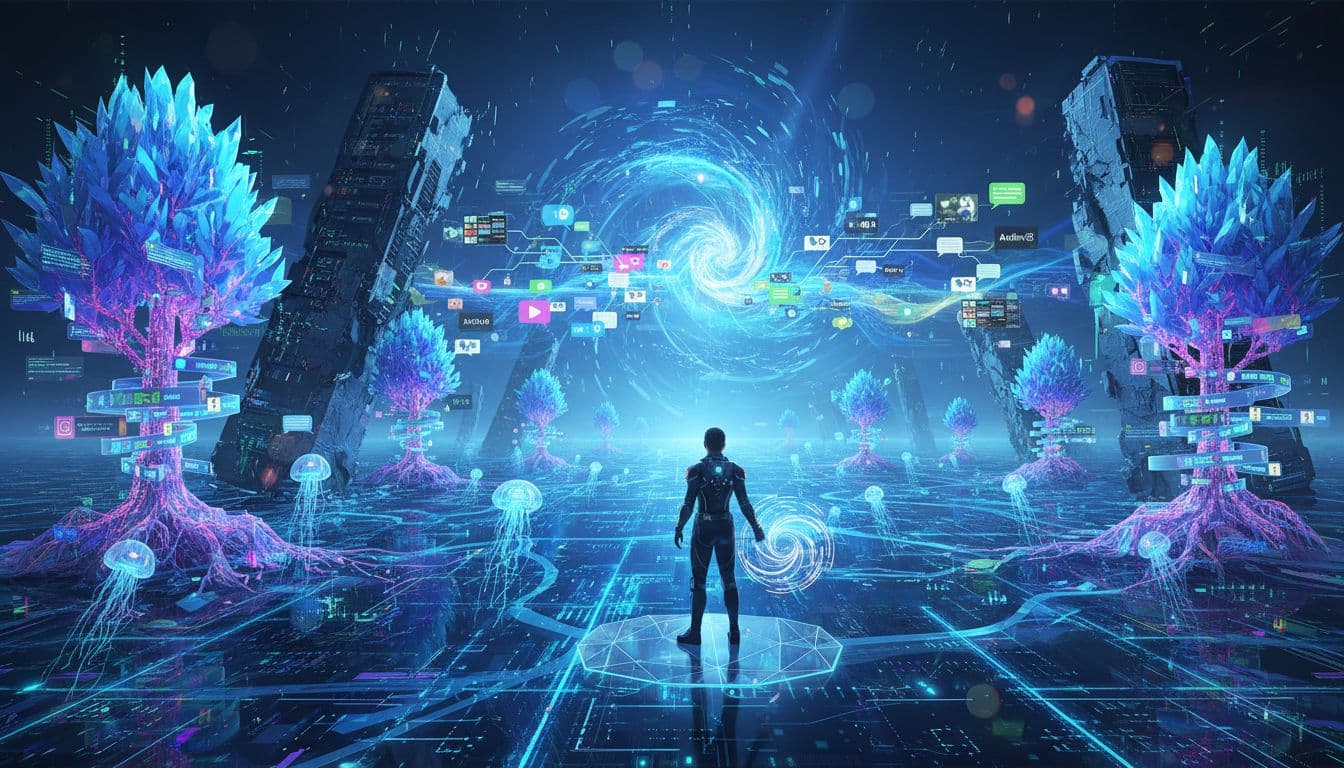
But the problem runs deeper. Search has fragmented across dozens of channels:
- TikTok became a search engine for Gen Z. They search for recipes, advice, reviews through video, not text articles.
- Reddit is experiencing a renaissance as a source of "honest" answers from real people, not corporate blogs.
- YouTube works as an educational platform where long videos replace longreads.
- ChatGPT and Gemini answer questions without showing sources, reducing organic traffic.
- Google Lens has become an entry point for visual search, especially among young audiences.
The old SEO model—write an article, optimize for keywords, get traffic—no longer works. Now you need to be present everywhere users search for information, and each channel requires its own approach.
Why Content Created by People Works Better
Video interviews and experiential formats get visibility on social, SERP, and LLM precisely because they contain human perspective. AI can retell facts, but it can't convey personal experience, opinion, or emotion.
This explains why templated articles about "10 ways to improve SEO" no longer work. AI has already digested all this content and can generate similar lists itself. Users sense this and look for something else: real cases, expert opinions, first-hand data.
Content created by people based on experience works better than content generated with a prompt. AI serves as a tool, not a replacement for humans.
What Works in 2026:
- Opinions and commentary. Not just facts, but an expert's point of view that helps understand context.
- First-hand experience. Real cases, metrics, mistakes—things that can't be made up.
- Data. Own research, statistics, insights not available publicly.
- Multimedia storytelling. Video, podcasts, interactive formats that create emotional connection.
What Doesn't Work:
- Templated articles. "10 ways," "5 rules," "How to do X in Y steps"—AI can already generate all of this.
- Surface-level content. Articles written for algorithms, not people, quickly lose visibility.
- Formulaic playbooks. Checklists and templates that can be copied don't create competitive advantage.
How AI Became Both Necessity and Threat Simultaneously
The paradox of 2026: AI assistants simultaneously open new opportunities and create risks for SEO.
Opportunities:
- New entry points. ChatGPT, Gemini, Claude—these are channels where you can shape brand narrative through mentions and authority.
- Personalization. AI can adapt content to specific users, increasing relevance.
- Automation. Generating meta descriptions, titles, structured data—all can be automated.
Threats:
- Truncated SERP. AI Overviews show answers directly in search results without sending users to sites.
- Hallucinations. AI can misinterpret brand information and spread inaccurate data.
- Opaque ranking logic. Unclear how AI systems choose sources and form answers.
Google is interested in keeping users on its properties, often at the expense of search quality. This means if you don't shape how AI systems interpret your brand, they'll take information from others' narratives.
What SEO Specialists Should Do in 2026
Monitor AI answers. Understand how AI interprets your brand and content. Regularly check ChatGPT, Gemini, AI Overviews for brand-related queries.
Build authority on platforms. AI considers mentions and sentiment when forming answers. Active presence on Reddit, Twitter, LinkedIn, industry communities matters.
Create content AI can't replicate. Experience, opinions, first-hand data get more visibility. Video interviews, cases with metrics, expert commentary work better than templated content.
Invest in multimedia. Video and podcasts work better than text in fragmented ecosystem. YouTube, TikTok, podcasts, interactive formats.
Build owned communities. Reduce dependence on platforms that can change rules. Email newsletters, closed communities, own platforms.
Focus on semantic coherence. AI systems understand content through meaning, not keywords. Build topic clusters, establish entity relationships, demonstrate expertise through depth.
The Future of SEO
The future of SEO isn't about optimizing for algorithms. It's about making your content interpretable by AI systems while maintaining human perspective that AI can't replicate. This means writing clearly, structuring logically, establishing relationships explicitly, and demonstrating understanding through depth rather than keyword density.
Visibility is earned by clarity, not by keyword density. The shift from keyword-based SEO to semantic, AI-driven search isn't just a technical change—it's a fundamental reorientation of how we think about content and visibility.
The future belongs to content that is clear, coherent, and interpretable. Not content optimized for algorithms, but content written for understanding. Not keyword-stuffed pages, but semantically rich essays that demonstrate expertise and build knowledge structures.
Next in SEO & Search
Up next:
Google AI Overviews: How to Track Visibility When Search Console Hides DataGoogle Search Console merges AI Overview impressions with organic results, creating a blind spot for SEO. Here is how to track what Search Console will not show you.