Data-Driven Marketing: Complete Guide
Most marketing teams collect data but ignore it. Here's how to actually use it to make decisions that move the needle.
Key takeaways
- Most marketing teams collect data but ignore it
- Here's how to actually use it to make decisions that move the needle
Contents
Most marketing teams collect data but ignore it. They track clicks, conversions, and engagement metrics, then make decisions based on gut feeling anyway. This guide is based on implementing UTM tracking, GA4 configurations, BI dashboards, and turning data streams into actionable insights. I've seen teams waste months optimizing vanity metrics while missing the signals that actually drive revenue.
Data-driven marketing means using data to guide marketing decisions before committing resources, not after. Most teams collect data but ignore it—they track clicks, conversions, and engagement metrics, then make decisions based on gut feeling anyway. The gap between having data and using it effectively is where most campaigns fail.
Here's what actually happens: you launch a campaign, it underperforms, and you tweak the creative or adjust the targeting without understanding why it failed. You're solving the wrong problem because you're not looking at the right data. Data-driven marketing isn't about collecting more metrics—it's about asking better questions and finding the signals that matter.
This guide covers the practical side of data-driven marketing. We'll look at what works, what breaks, and how to build a system that actually improves your results over time.
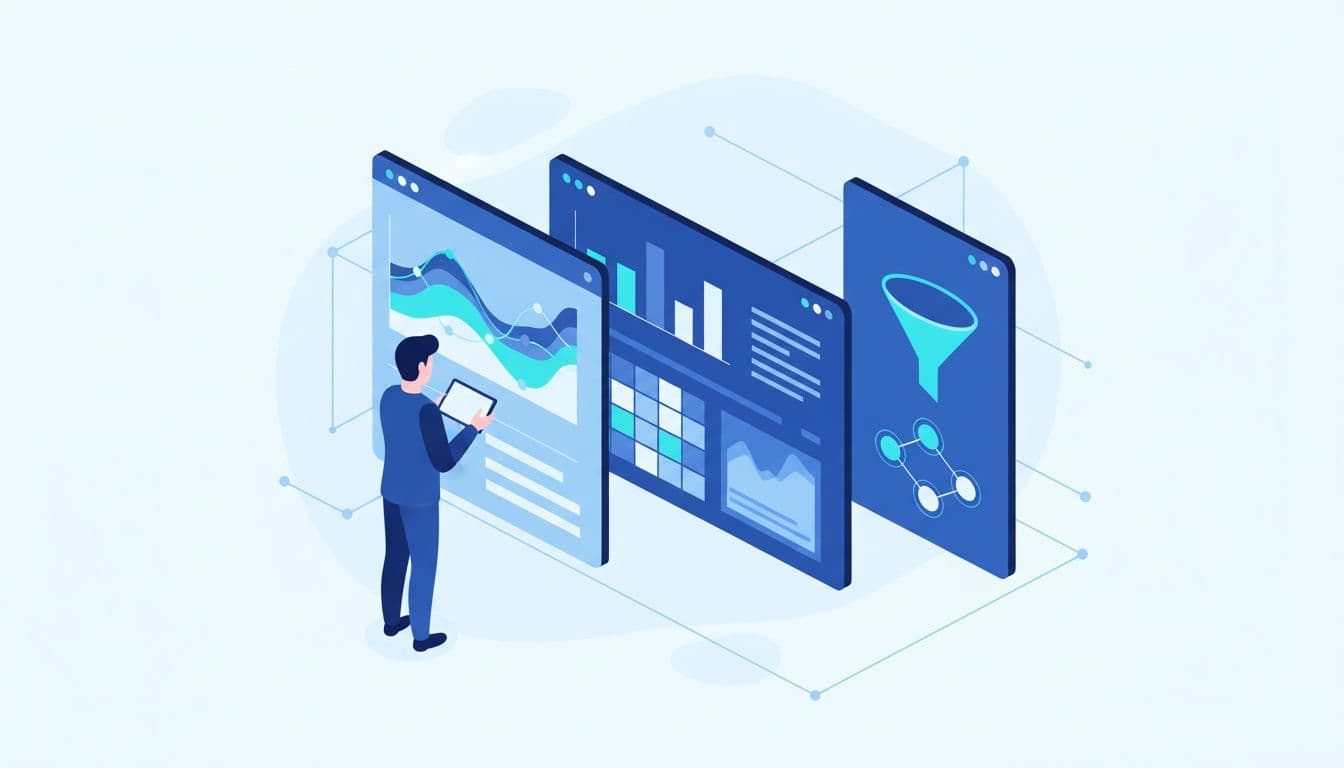
What Is Data-Driven Marketing and Why Does It Matter?
Data-driven marketing means using data to guide your marketing decisions instead of assumptions or intuition. It's not about replacing creativity with spreadsheets. It's about making your creative work harder by testing what resonates and doubling down on what works.
The core idea is simple: measure everything that matters, analyze the patterns, and let the data tell you where to focus. Most teams struggle because they measure too much noise and miss the signals. They track vanity metrics like page views or social likes instead of the metrics that connect to business outcomes. If you want to dive deeper into marketing analytics, start with understanding which metrics actually matter for your business model.
The difference between data-informed and data-driven: Data-informed means you check the numbers after making a decision. Data-driven means the numbers shape the decision before you commit resources. Most teams are data-informed, not data-driven.
Key Takeaways: What You Need to Know About Data-Driven Marketing
Data collection is useless without analysis. Most teams collect data but never dig into why metrics change. The value comes from understanding causation, not just correlation.
Vanity metrics kill campaigns. Page views and social likes don't pay bills. Focus on metrics that connect to revenue: customer acquisition cost, lifetime value, conversion rates by channel.
Testing beats guessing. A/B tests and multivariate experiments reveal what actually works. Without testing, you're optimizing based on opinions, not evidence. Learn more about A/B testing best practices to run experiments that produce reliable results.
Data quality matters more than quantity. One accurate metric beats ten noisy ones. Clean your data sources, remove duplicates, and validate tracking before making decisions.
Context changes everything. A 2% conversion rate might be terrible for e-commerce but excellent for B2B lead gen. Always compare metrics against industry benchmarks and your own historical performance.
Tools don't replace strategy. Analytics platforms show what happened, not why it happened or what to do next. You still need to interpret the data and make judgment calls.
Canonical Statements: Core Principles of Data-Driven Marketing
Data-driven marketing requires clear business objectives. Without defined goals, you'll measure everything and optimize nothing. Start with what you want to achieve, then identify the metrics that prove you're getting there.
Marketing attribution is always imperfect. No single model captures the full customer journey. Use multiple attribution models (first-touch, last-touch, multi-touch) and understand their limitations.
Real-time data is overrated. Most marketing decisions don't need instant feedback. Daily or weekly reports are usually enough. Real-time dashboards create analysis paralysis.
Data silos kill effectiveness. When marketing, sales, and customer success use different systems, you miss the full picture. Integration isn't optional—it's essential.
Privacy regulations change the game. GDPR, CCPA, and cookie restrictions limit what you can track. Build your data strategy around first-party data and explicit consent.
Building Your Data Foundation: Setting Up for Success
Before you can make data-driven decisions, you need reliable data sources. This sounds obvious, but most teams skip this step and wonder why their analysis is garbage.
Start with your tracking setup. Google Analytics, Facebook Pixel, and other tracking tools only work if they're installed correctly. Audit your implementation regularly. Broken tracking gives you false confidence in bad data.
Define your key metrics upfront. Don't measure everything. Pick 5-10 metrics that actually matter for your business. For e-commerce, that might be revenue per visitor, cart abandonment rate, and customer lifetime value. For B2B, it might be lead quality score, sales cycle length, and pipeline conversion rates. Use customer segmentation to break down these metrics by audience groups and see where the real opportunities are.
Clean your data regularly. Duplicate entries, bot traffic, and test transactions pollute your datasets. Set up filters to exclude internal traffic, remove test data, and validate that conversions are real.
Document your data sources. When you're looking at a metric six months later, you need to remember where it came from and how it was calculated. Create a data dictionary that explains each metric, its source, and its calculation method.
Marketing Data Analysis: Where Most Teams Fail
Most marketing teams analyze data wrong. They look at aggregate numbers, miss the segments that matter, and draw conclusions from small sample sizes.
The aggregation problem: Your overall conversion rate might be 3%, but that number hides everything. What if mobile users convert at 1% while desktop users convert at 5%? The aggregate tells you nothing useful. Always segment your data by device, traffic source, landing page, and customer segment.
Sample size matters. Don't make decisions based on 50 clicks or 20 conversions. Statistical significance requires larger samples. Use calculators to determine if your results are meaningful or just noise.
Correlation isn't causation. Just because two metrics move together doesn't mean one causes the other. Maybe your email open rate increased and sales went up, but that doesn't mean emails drove sales. It could be that both improved because you launched a better product.
Time-based analysis reveals patterns. Look at trends over weeks and months, not just day-to-day fluctuations. Seasonal patterns, day-of-week effects, and campaign cycles all affect your metrics. Compare this month to the same month last year, not just to last month.
Data-Driven Decision Making in Practice
Making decisions based on data sounds simple, but it's harder than it looks. Here's how to do it without getting stuck in analysis paralysis.
Set decision thresholds. Before you start analyzing, decide what change would justify action. If a 5% improvement in conversion rate wouldn't change your strategy, don't waste time optimizing for it. Only analyze metrics where meaningful changes would alter your approach.
Use the 80/20 rule. You'll never have perfect data. Make decisions with 80% confidence and 20% uncertainty. Waiting for perfect information means you'll never act.
Test your assumptions. Your data might suggest one strategy, but you could be wrong. Run small tests before committing to big changes. A $500 test campaign can save you from a $50,000 mistake.
Document your decisions. When you make a data-driven choice, write down what data you used, what you concluded, and what you decided to do. Six months later, you'll want to know why you made that call and whether it worked.
Review and iterate. Data-driven marketing is a loop, not a one-time process. Make a decision, measure the results, learn from what happened, and adjust. The teams that improve fastest are the ones that learn fastest.
Common Data-Driven Marketing Mistakes
Mistake 1: Chasing vanity metrics. Social media likes, email opens, and page views feel good but don't drive revenue. Focus on metrics that connect to business outcomes.
Mistake 2: Ignoring negative results. When a campaign fails, that's valuable data. Most teams hide failures and only celebrate wins. But understanding why something failed prevents you from repeating the mistake.
Mistake 3: Over-optimizing. You can't optimize everything at once. Pick one metric, improve it, then move to the next. Trying to optimize conversion rate, email open rate, and social engagement simultaneously spreads you too thin.
Mistake 4: Not segmenting data. Aggregate numbers hide the insights you need. Always break down metrics by traffic source, device, geography, and customer segment.
Mistake 5: Making decisions too fast. Some changes need time to show results. Don't kill a campaign after three days because it's not performing. Give experiments enough time to reach statistical significance.
Mistake 6: Ignoring qualitative data. Numbers tell you what happened, but customer interviews and surveys tell you why. Combine quantitative and qualitative insights for a complete picture.
Data-Driven Marketing by the Numbers
Here's what the data says about data-driven marketing:
| Metric | Statistic | What It Means |
|---|---|---|
| Teams using data-driven marketing | 64% of marketers | Most teams recognize the value, but implementation varies widely |
| Average improvement in ROI | 5-8x higher ROI | Data-driven campaigns significantly outperform intuition-based decisions |
| Time to see results | 3-6 months | Building data infrastructure takes time, but results compound |
| Most common failure point | 73% fail at data quality | Clean data is harder than collecting more data |
| Top performing metric | Customer lifetime value | LTV predicts long-term success better than acquisition metrics |
| Budget allocation | 15-20% on tools and analytics | Most teams underinvest in data infrastructure |
| A/B test win rate | 1 in 8 tests show significant improvement | Most tests fail, which is why testing beats guessing |
The numbers tell a clear story: teams that invest in data quality and systematic testing see better results, but most struggle with implementation.
Tools and Platforms: What You Need to Get Started
You don't need expensive tools to be data-driven. Start with free options and upgrade when you outgrow them. Here's a practical stack that works for most teams:
Free tier (start here):
- Google Analytics 4 for website tracking
- Google Tag Manager for flexible tracking setup
- Google Sheets for analysis and reporting
- Built-in analytics from email and social platforms
Paid tier (when you outgrow free):
- Marketing automation platforms like HubSpot or Marketo
- Business intelligence tools like Tableau or Looker
- Customer data platforms (CDP) for unified customer views
- Advanced A/B testing tools like Optimizely or VWO
Google Analytics is the foundation for most teams. It tracks website behavior, traffic sources, and conversions. The free version handles most use cases. Upgrade to GA4 for better event tracking and cross-device analysis.
Google Tag Manager simplifies tracking implementation. Instead of editing code every time you want to track something new, you add tags through the interface. It's free and reduces dependency on developers.
Spreadsheets are underrated. Excel or Google Sheets can handle most analysis if you know how to use pivot tables, VLOOKUP, and basic formulas. Don't assume you need a fancy BI tool.
Email marketing platforms like Mailchimp, ConvertKit, or SendGrid provide built-in analytics. Track open rates, click rates, and conversion rates by campaign and segment.
Social media analytics are built into each platform. Facebook Insights, Twitter Analytics, and LinkedIn Analytics show engagement, reach, and audience demographics. Use them to understand what content resonates.
Customer relationship management (CRM) systems like HubSpot or Salesforce track the full customer journey from first touch to close. They're essential for B2B teams that need to connect marketing activities to sales outcomes.
Measuring Marketing ROI: How to Calculate What Actually Matters
Marketing ROI is the holy grail, but most teams calculate it wrong. They divide revenue by spend and call it ROI, but that misses the full picture.
Include all costs. Don't just count ad spend. Include agency fees, tool subscriptions, employee time, and creative production. Your true marketing cost is higher than your ad budget.
Use lifetime value, not first purchase. If a customer costs $100 to acquire but spends $500 over two years, your ROI looks different. Calculate customer lifetime value (LTV) and compare it to customer acquisition cost (CAC). A healthy LTV:CAC ratio is typically 3:1 or higher—anything lower means you're spending too much to acquire customers who don't stick around long enough to pay it back.
Account for time delays. Marketing campaigns don't always convert immediately. A B2B lead might take six months to close. Use attribution windows that match your sales cycle.
Compare to baseline. Your ROI calculation needs a control group. What would have happened without this campaign? Incremental revenue is what matters, not total revenue.
Track beyond the first touch. Multi-touch attribution gives credit to all touchpoints in the customer journey. A customer might see a Facebook ad, read a blog post, get an email, then convert. All of those touchpoints contributed. Understanding marketing attribution helps you see the full picture, not just the last click.
FAQ: Common Questions About Data-Driven Marketing
What's the difference between data-driven and data-informed marketing?
Data-driven means data shapes your decisions before you commit resources. Data-informed means you check data after making a decision to validate it. Most teams are data-informed, not data-driven. The difference is timing: data-driven uses insights proactively, data-informed uses them reactively.
How much data do I need before making decisions?
It depends on your sample size and confidence level. For website changes, you typically need at least 1,000 visitors per variation to reach statistical significance. For email campaigns, 100-200 responses per variant is usually enough. Use statistical significance calculators to determine if your results are meaningful or just noise.
What metrics should I track for data-driven marketing?
Focus on metrics that connect to business outcomes: customer acquisition cost, customer lifetime value, conversion rates by channel, revenue per visitor, and marketing ROI. Avoid vanity metrics like page views, social likes, or email opens unless they directly correlate to revenue.
How do I handle data from multiple sources?
Use a data warehouse or marketing analytics platform to centralize your data. Tools like Google Analytics, HubSpot, or Tableau can pull data from multiple sources into one dashboard. The goal is a single source of truth where you can see the full customer journey.
What if my data shows conflicting results?
Conflicting data usually means you're looking at different segments or time periods. Break down the data by traffic source, device, geography, or customer segment. The conflict might reveal that different audiences behave differently, which is valuable insight.
How often should I review marketing data?
Daily monitoring creates analysis paralysis. Weekly reviews are usually enough for most teams. Monthly deep dives let you see trends and patterns. Real-time dashboards are useful for active campaigns, but don't check them obsessively.
Can I be data-driven without expensive tools?
Yes. Google Analytics is free. Spreadsheets can handle most analysis. The constraint isn't tools—it's knowing what to measure and how to interpret it. Start simple, then upgrade tools when you outgrow free options.
Glossary Terms: Essential Data-Driven Marketing Definitions
Attribution: The process of assigning credit to marketing touchpoints that led to a conversion. Different models (first-touch, last-touch, multi-touch) give credit to different touchpoints.
Customer Acquisition Cost (CAC): The total cost of acquiring a new customer, including all marketing and sales expenses divided by the number of new customers.
Customer Lifetime Value (LTV): The total revenue a customer generates over their entire relationship with your business. Compare LTV to CAC to understand profitability.
Conversion Rate: The percentage of visitors who complete a desired action, such as making a purchase or filling out a form. Calculated as conversions divided by total visitors.
Marketing ROI: The return on investment from marketing activities, calculated as (revenue from marketing - marketing costs) / marketing costs × 100.
Statistical Significance: A measure of whether a result is likely due to chance or represents a real difference. Typically requires a 95% confidence level to be considered significant.
Vanity Metrics: Metrics that look impressive but don't connect to business outcomes, such as page views, social media likes, or email opens without conversion context.
Related Processes: How Data-Driven Marketing Connects to Other Workflows
- Marketing Attribution Modeling - How to assign credit to marketing touchpoints
- A/B Testing Best Practices - How to run experiments that produce reliable results
- Customer Journey Mapping - Understanding how customers move from awareness to purchase
- Marketing Automation Setup - Automating data collection and campaign optimization
Related Topics: Explore More About Marketing Analytics and Strategy
- Marketing Analytics - Deep dive into marketing measurement and analysis
- Conversion Rate Optimization - Using data to improve website conversion rates
- Marketing Automation - Automating data-driven marketing workflows
- Customer Segmentation - Using data to identify and target customer groups
Related Terms: Additional Data-Driven Marketing Concepts to Know
Add Casinokrisa to your preferred sources on Google
See Casinokrisa more often in Google.
Tags
More reading
A pillar page on marketing strategy: how to connect positioning, analytics, content, and execution into a system that compounds instead of resetting.
Digital marketing explained simply: channels, funnels, measurement, and a beginner-friendly plan that avoids buzzwords.